

Dual-Wavelength Endolaser for Medical Aesthetics: ENDO ONE’s Selectable Modes and Precise Tissue Targeting
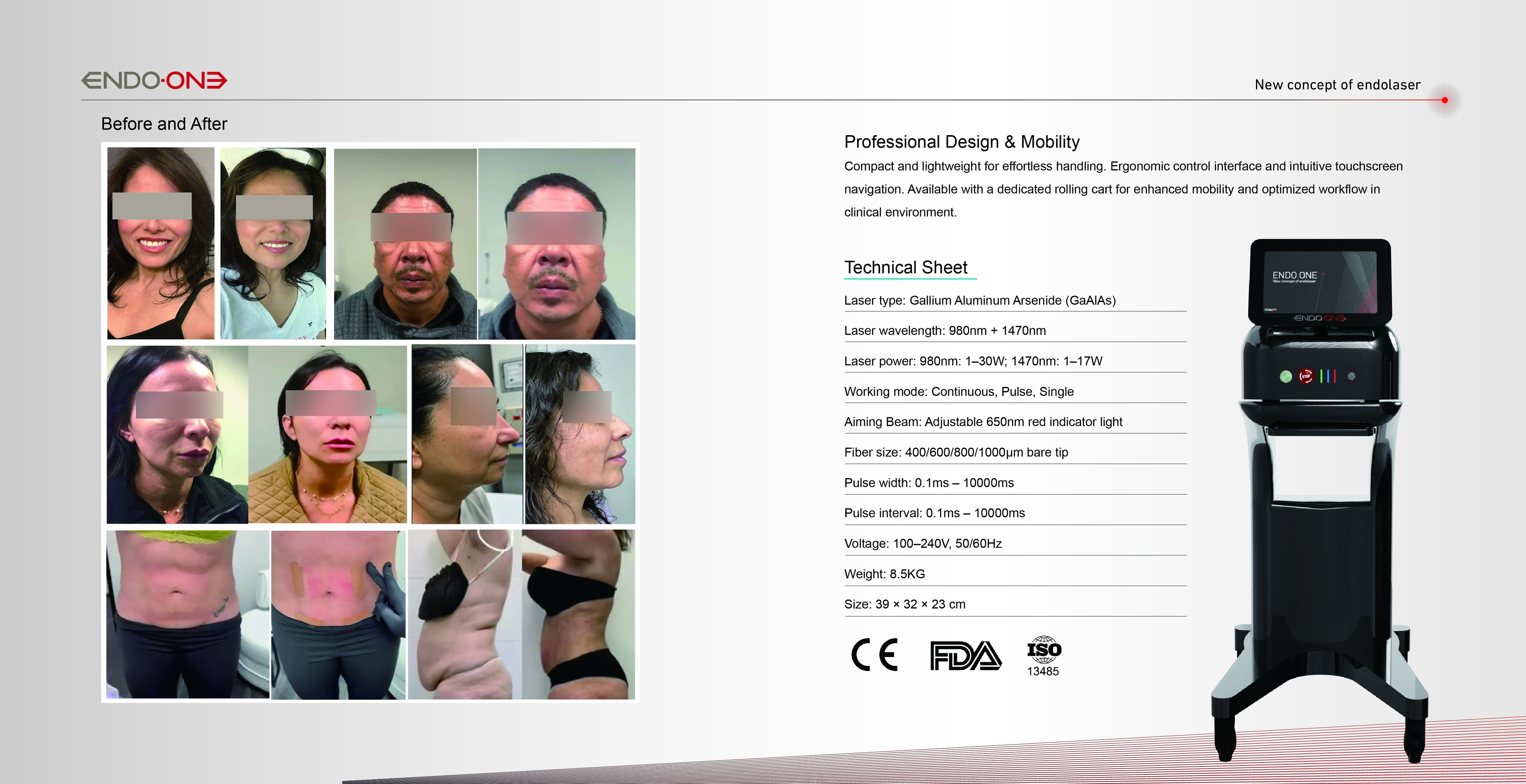
The ENDO ONE platform, engineered in Italy by ENDO ONE SRL, incorporates dual semiconductor diode wavelengths within an integrated GaAlAs laser system. By combining 980 nanometer and 1470 nanometer emissions, the device allows medical practitioners to select single or combined operating modes tailored to patient-specific clinical indications. This biophysical flexibility ensures targeted subcutaneous thermal heating, minimal collateral thermal spread, and high clinical predictability across facial and body applications.
Semiconductor Laser Physics and Dual-Wavelength Architecture
Grounded in the established biophysical principles of selective photothermolysis formulated by Anderson and Parrish, targeted photothermal therapy relies on matching laser emission wavelengths to the primary absorption bands of target chromophores in human tissue. Traditional single-wavelength lasers restrict clinicians to addressing either vascular and fatty structures or water-rich dermal collagen networks. This clinical trade-off forces practices to compromise on clinical endpoints or purchase multiple capital devices.
Integrating two complementary wavelengths allows practitioners to address multi-layered aesthetic concerns in a single procedural session. Clinicians can adjust emission ratios based on whether the clinical objective requires volumetric fat remodeling, soft-tissue contraction, or microvascular coagulation. Delivering optical energy through bare-tip quartz fibers directly into the target layer ensures high power transmission with minimal epidermal interaction. Utilizing a dual-wavelength endolaser for medical aesthetics provides treating physicians with exceptional procedural control over diverse anatomical tissue beds.
The Photothermal Mechanism of the 980 Nanometer Wavelength
The 980 nanometer wavelength demonstrates moderate absorption in water combined with high optical affinity for hemoglobin and lipids. When delivered into subcutaneous adipose compartments, this wavelength converts light energy into thermal energy to liquefy adipocyte cell membranes. The resulting emulsification converts solid adipose clusters into a low-viscosity emulsion that can be naturally resorbed by macrophages or gently micro-aspirated.
Concurrently, energy absorption by hemoglobin coagulates microvascular networks surrounding targeted fat deposits. This simultaneous vascular coagulation minimizes procedural bleeding, reduces post-treatment ecchymosis, and accelerates patient recovery. Operating at 980 nanometers provides exceptional control when treating vascularized fat compartments in the lower face and submental zones.
Water Absorption Dynamics of the 1470 Nanometer Wavelength
The 1470 nanometer wavelength aligns with a prominent peak in the infrared water-absorption spectrum. Because human soft tissue consists predominantly of water, this wavelength concentrates thermal energy within extracellular and intracellular fluid matrices. The water absorption coefficient of 1470 nanometers is approximately forty times higher than that of 980 nanometers, ensuring rapid, localized thermal conversion.
High water absorption restricts thermal penetration depth, preventing untargeted energy migration into underlying muscular or osseous structures. Energy absorbed by interstitial water induces rapid heating of adjacent type I and type III collagen fibrils, triggering immediate protein contraction and delayed neocollagenesis. This dynamic makes 1470 nanometers the optimal wavelength for tightening lax skin across the face, neck, and delicate anatomical contours.
Selectable Emission Modes and Energy Delivery Controls
Controlling thermal diffusion within tissue planes requires precise modulation of laser emission timing. Operating modes must balance effective peak power delivery with adequate thermal relaxation to protect surrounding tissue structures. Uncontrolled continuous heating risks thermal accumulation and adverse scarring, whereas inadequate thermal dosing yields negligible tissue tightening.
The platform provides independent control over energy output, pulse duration, and pulse intervals, enabling practitioners to tailor energy delivery to regional tissue resistance and vascularity. Operators can configure continuous wave, pulsed wave, or single-pulse outputs to match specific procedural demands.
Continuous Wave Delivery for Progressive Thermal Accumulation
Continuous wave emission delivers uninterrupted optical energy as the practitioner navigates the optical fiber through subcutaneous tunnels. This delivery mode supports steady, cumulative thermal elevation across broad treatment vectors.
Clinicians employ continuous wave delivery primarily in extensive anatomical zones, such as the lower abdomen or mid-face, where broad tissue heating is necessary to achieve uniform contraction. Continuous fiber motion remains mandatory to prevent localized hot spots. The operator continuously tracks the optical fiber tip using the transilluminating red aiming beam, maintaining fluid retrograde passes to distribute energy evenly across the reticular dermis.
Pulsed and Single-Pulse Modes for Thermal Relaxation Management
Pulsed delivery introduces precise bursts of optical energy separated by planned cooling intervals. Modulating the duty cycle allows targeted tissues to absorb therapeutic thermal energy while preventing heat accumulation beyond safety thresholds.
Single-pulse mode permits localized delivery for focal tissue modifications, such as treating discrete fibrotic acne scars or isolated vascular anomalies. Practitioners can calibrate pulse widths and intervals from 0.1 milliseconds to 10,000 milliseconds to match specific tissue relaxation constants. This precise temporal control preserves delicate micro-vascular structures while focusing thermal energy entirely on pathological scar bands or lax septal fibers.
Technical Specifications and Optical Hardware Integration
The platform combines solid-state semiconductor diode architecture with digital microprocessor control to maintain stable optical output across extended clinical procedures. Solid-state diode arrays eliminate the high consumable and maintenance overhead associated with older flashlamp or dye lasers.
System parameters and hardware configurations include:
Laser Source: Gallium Aluminum Arsenide (GaAlAs) semiconductor diode system.
Wavelength Outputs: 980 nanometers and 1470 nanometers.
Power Range for 980 Nanometers: Adjustable from 1 watt to 30 watts.
Power Range for 1470 Nanometers: Adjustable from 1 watt to 17 watts.
Operational Modes: Continuous Wave, Pulsed Wave, and Single Pulse emission.
Pulse Duration and Interval Range: Adjustable between 0.1 milliseconds and 10,000 milliseconds.
Aiming Beam System: Red indicator beam operating at 650 nanometers with adjustable intensity.
Physical Dimensions: Chassis measuring 39 centimeters by 32 centimeters by 23 centimeters.
Total System Weight: Eight and a half kilograms for effortless clinical mobility.
Fiber Caliber Selection for Depth-Specific Tissue Targeting
Optical energy is transmitted through sterile, flexible silica fibers featuring polished bare tips. Matching core diameter to anatomical depth ensures uniform energy distribution and prevents mechanical tissue tearing.
Small-Caliber Fibers for Delicate Cutaneous Planes
Fibers measuring 400 micrometers provide high mechanical flexibility and minimal entry-site trauma. These ultra-fine calibers navigate thin dermal layers across the periorbital eyelids, perioral lines, and superficial acne scar tethers.
The concentrated spot size delivers high energy density at conservative power outputs, ensuring localized thermal remodeling without thermal damage to delicate overlying skin. Clinicians pass the 400 micrometer optical fiber into the subdermal target plane through a minimal puncture site created with an 18-gauge or 20-gauge pilot needle, eliminating the need for surgical skin incisions.
Larger Bare-Tip Fibers for Subcutaneous and Adipose Vectors
Fibers measuring 600 micrometers and 800 micrometers offer greater column strength, allowing practitioners to tunnel through denser fibrous septa across the lower face, neck, and body.
The broader optical field distributes energy efficiently across larger tissue volumes, accelerating treatment times during comprehensive body contouring procedures while maintaining uniform subcutaneous heating. When addressing dense fibrotic tissue or thick abdominal adipose layers, fibers measuring up to 1000 micrometers provide the physical rigidity needed for steady manual passes.
Frequently Asked Questions About Dual-Wavelength Laser Systems
What clinical advantage does a dual-wavelength platform provide over single-wavelength devices?
A dual-wavelength system allows clinicians to target both vascular lipid complexes and interstitial water using one console. Practitioners can address skin laxity and localized fat deposits in a single procedural session without switching devices. This dual absorption dynamic expands treatment versatility while optimizing practice capital expenditure.
How does the 650 nanometer aiming beam improve procedural safety?
The adjustable red aiming beam transilluminates through the patient skin surface, providing real-time visual tracking of the fiber tip. Clinicians can verify subcutaneous depth and prevent superficial placement that could cause epidermal blistering. Continuous transillumination ensures that laser energy is delivered precisely within the designated anatomical plane.
Can the two wavelengths be operated simultaneously?
The system supports selectable single-wavelength emission as well as combined dual-wavelength output. Practitioners can customize energy ratios based on whether the clinical objective prioritizes fat lipolysis or dermal tightening. This simultaneous delivery accelerates procedures involving both adiposity and skin laxity, such as submental sculpting.
What fiber sizes are compatible with the system?
The platform supports bare-tip silica optical fibers in diameters of 400, 600, 800, and 1000 micrometers. Clinicians select fiber calibers based on anatomical tissue thickness and procedure invasiveness. Small diameters serve periorbital and fine line indications, while larger calibers treat deep facial and body contours.
What maintenance is required for semiconductor diode laser systems?
Solid-state GaAlAs diode lasers require minimal ongoing maintenance compared to flashlamp-pumped or gas laser systems. Practices perform routine optical connector inspection and standard electrical safety checks following manufacturer guidelines. The absence of consumable gas canisters or dye kits ensures low operational costs.
Evaluating Platform Integration for Advanced Medical Aesthetic Practices
Selecting an advanced endolaser platform requires balancing optical versatility, equipment reliability, and clinical safety controls. Dual-wavelength semiconductor systems expand procedural offerings while maintaining low consumable costs and high patient throughput.
Practices seeking detailed technical specifications, optical calibration sheets, or clinical integration guidance for dual-wavelength endolaser for medical aesthetics can submit inquiries through the official consultation portal. Integrating versatile dual-wavelength diode technology equips clinics to address complex facial and body indications with high clinical precision. Explore comprehensive technical resources and schedule an evaluation consultation at https://www.endo-one-prime.com/ to review clinical integration pathways for your practice.
ENDO ONE SRL
ENDO ONE SRL
email us here
Legal Disclaimer:
EIN Presswire provides this news content "as is" without warranty of any kind. We do not accept any responsibility or liability for the accuracy, content, images, videos, licenses, completeness, legality, or reliability of the information contained in this article. If you have any complaints or copyright issues related to this article, kindly contact the author above.
