

Atopic Dermatitis Market to reach USD 48.53 Billion by 2035 at 8.9% CAGR
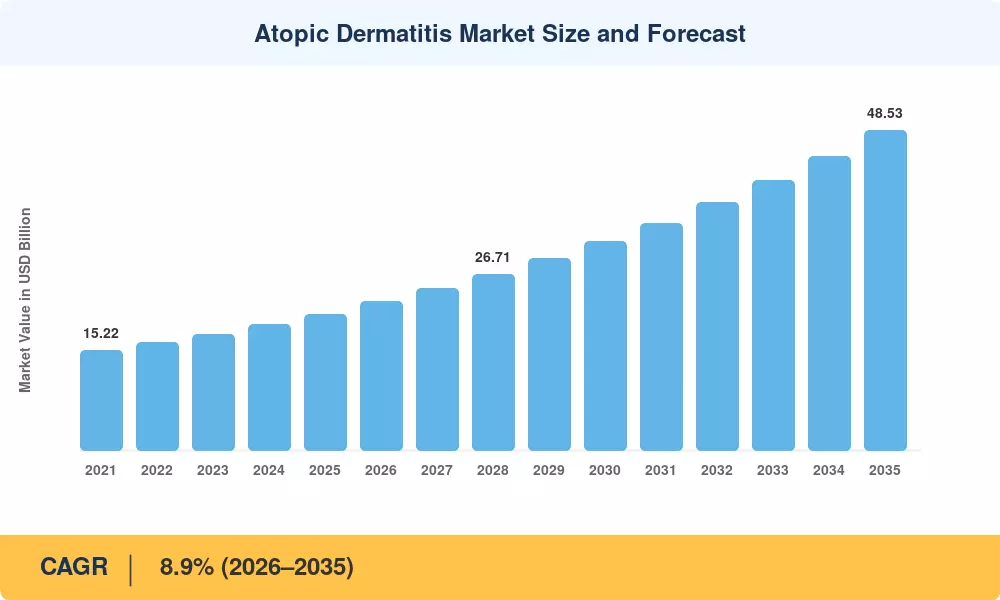
Atopic Dermatitis Market (2026 - 2035)
Atopic Dermatitis Market to Surge from USD 20.69 Billion in 2025 to USD 48.53 Billion by 2035—By Pediatric Label Expansion, Asian Reimbursement Acceleration
NY, CA, UNITED STATES, September 17, 2026 /EINPresswire.com/ -- As per Market Research Future, the global Atopic Dermatitis Market size is projected to reach USD 48.53 Billion by 2035 from USD 20.69 Billion in 2025, at a CAGR of 8.9% during the forecast period 2026–2035. The market base was estimated at USD 20.69 Billion in 2025, with the first year of the forecast period (2026) valued at USD 22.53 Billion.The 8.9% CAGR is propelled by three converging forces: pediatric label expansion, with biologic and JAK inhibitors now approved for younger age groups, and early initiation locking in decades of therapy while potentially altering the atopic march toward asthma and allergic rhinitis; Asian reimbursement acceleration, with China's National Reimbursement Drug List adding interleukin-targeted dermatology agents and collapsing a reimbursement lag that once ran four to five years; and digital triage shortening the path to specialists, with AI-assisted image triage increasingly deployed across integrated delivery networks to filter routine cases and optimize specialist slot allocation.
Global policy shifts and therapeutic innovation are amplifying this momentum. The US Inflation Reduction Act's Medicare Part D redesign capped annual out-of-pocket spending at USD 2,000 from January 2025, materially improving adherence economics for high-cost dermatology injectables. In 2024, Sanofi and Regeneron's combined Dupixent worldwide net sales exceeded USD 14.1 billion, reconfiguring dermatology as a legitimate primary-care-adjacent sector. North America represents 38.8% of global sales, driven by extensive commercial coverage and dense expert networks, while Asia-Pacific is the fastest-growing region at a CAGR of 10.2% through 2035. Europe is the second largest block on the strength of NICE and G-BA pathways that currently pass biologics within twelve months of EMA action.
Request A Free Sample:
https://www.marketresearchfuture.com/sample_request/1610
Key Market Trends & Growth Drivers
Pediatric Label Expansion Rewrites Lifetime Value
Biologic and JAK inhibitors have progressively secured approvals for younger age groups, with the leading IL-4Rα agent now cleared from six months of age in major markets. Early initiation locks in decades of therapy, and the argument that sustained disease control may alter the atopic march toward asthma and allergic rhinitis is now deployed in HTA submissions. The pediatric cohort is the strategic prize inside the Atopic Dermatitis Market.
Asian Reimbursement Timelines Collapsed
China's National Healthcare Security Administration negotiated dermatology biologics into the NRDL with price concessions averaging 55–62%, but paired those cuts with volume guarantees across roughly 1,400 tertiary hospitals. Japan's Chuikyo maintained biologic listing within 90 days of PMDA approval, and Korea's HIRA extended coverage to moderate disease in 2024. The result is a compressed adoption curve: markets that once trailed the United States by half a decade now trail by eighteen months.
Digital Triage Shortens the Path to Specialists
Dermatology waiting lists remain the binding constraint in publicly funded systems. NHS England tracks substantial median waits for routine dermatology appointments, which are heavily constrained as two-week targets for suspected cancer pathways absorb primary clinical capacity. AI-assisted image triage is increasingly deployed across integrated delivery networks to help filter routine cases and optimize specialist slot allocation for moderate-to-severe patients.
Adherence Economics Improve With Cost Caps
Abandonment at the pharmacy counter has historically presented a major leak in dermatology treatment continuity. Policy mechanisms such as out-of-pocket spending caps and expanded manufacturer bridge programs directly target high patient cost-share thresholds, supporting improved long-term refill persistence and twelve-month continuation rates.
Ask for Customization:
https://www.marketresearchfuture.com/ask_for_customize/1610
Market Segment Insights
BY DRUG CLASS
Corticosteroids: Largest segment with 32.7% share in 2025 , still the volume backbone of first-line care. Will remain the largest class by revenue into the early 2030s, but their share is eroding roughly 90 basis points annually as non-steroidal maintenance displaces long-term use.
Biologics (IL-4/IL-13 inhibitors): Significant segment with 26.8% share in 2025 , driven by moderate-to-severe durable control. A single patient generates annual net revenue between USD 18,000 and USD 32,000 depending on market and rebate structure.
JAK Inhibitors: Fastest-growing class at 10.5% CAGR (2026–2035) , driven by rapid itch response.
Topical Calcineurin Inhibitors: Significant segment at USD 2.94 Billion in 2025, driven by steroid-sparing facial application.
PDE-4 Inhibitors: Significant segment with 9.6% share in 2025 , contributing roughly USD 1.99 Billion in revenue as non-steroidal maintenance gained traction.
BY ROUTE OF ADMINISTRATION
Topical: Largest segment with 57.5% share in 2025 , reflecting mild-to-moderate disease majority. Topical dominance reflects epidemiology rather than value—most diagnosed patients never escalate.
Injectable: Fastest-growing route at 9.9% CAGR (2026–2035) , driven by biologic class expansion. Injectables now account for roughly a quarter of the market despite treating under 8% of the diagnosed population.
Oral: Significant segment at USD 3.70 Billion in 2025, driven by rapid onset in refractory cases.
BY PATIENT AGE GROUP
Adult (18+ yrs): Largest segment with 53.1% share in 2025 , driven by higher systemic therapy conversion. Adults convert to high-value systemic therapy at roughly twice the pediatric rate.
Pediatric (0–17 yrs): Fastest-growing segment at 9.3% CAGR (2026–2035) , driven by infant and adolescent label expansion. Early initiation locks in decades of therapy.
BY DISTRIBUTION CHANNEL
Retail Pharmacy: Largest segment with 45.8% share in 2025 , driven by topical and oral prescription volume.
Hospital Pharmacy: Significant segment at USD 6.91 Billion in 2025, driven by biologic initiation and specialist dispensing.
Online / Tele-Dermatology: Fastest-growing channel at 10.9% CAGR (2026–2035) , driven by refill convenience and adherence programs.
Read Detailed Insights:
https://www.marketresearchfuture.com/reports/atopic-dermatitis-market-1610
Regional Outlook
North America — Dominant Market (~38.8% Share, 2025)
United States: Generates approximately 87.4% of regional revenue , driven by commercial biologic coverage breadth. Roughly 71% of biologic dermatology scripts route through limited-distribution networks that handle benefits investigation, copay assistance and injection training in one workflow.
Canada: Contributes USD 0.71 Billion, driven by pCPA joint negotiation efficiency. The pan-Canadian Pharmaceutical Alliance secured confidential rebates averaging 25–30% on dermatology biologics.
Mexico: Fastest-growing in the region at 9.4% CAGR (2026–2035) , driven by IMSS formulary expansion. IMSS added interleukin inhibitors to its Cuadro Básico in 2024, opening a public channel that had previously been closed.
Europe — Second Largest (USD 5.69 Billion, 2025)
Germany: Holds 24.1% of regional revenue , driven by AMNOG early benefit assessment speed. Germany's process delivers reimbursed market access from day one of launch.
United Kingdom: Contributes USD 0.86 Billion, driven by NICE technology appraisal throughput. NICE cleared multiple systemic dermatology agents through its technology appraisal route within 2023–2024.
France: Holds 15.8% of regional revenue , driven by ATU early-access pathway.
Italy: Contributes USD 0.53 Billion, driven by AIFA regional formulary alignment.
Spain: Holds 8.7% of regional revenue , driven by autonomous community tendering.
Nordic Countries: Growing at 9.1% CAGR (2026–2035) , driven by registry-based outcomes contracting. Nordic payers have gone furthest on outcomes contracting, tying rebate tiers to registry-confirmed EASI-75 response at week 16.
Russia: Contributes USD 0.24 Billion, driven by domestic substitution policy.
Rest of Europe: Holds 7.9% of regional revenue , driven by Central European access expansion.
Asia-Pacific — Fastest-Growing Region (10.2% CAGR, 2026–2035)
China: Holds 34.6% of regional revenue , driven by NRDL listing and hospital volume mandates. NRDL inclusion cut list prices by more than half while guaranteeing procurement, with unit volumes rising four- to sixfold within eighteen months of listing.
India: Fastest-growing in the region at 11.8% CAGR (2026–2035) , driven by diagnosed pool expansion and tiered pricing. India's diagnosed patient pool exceeds 30 million, yet systemic therapy penetration sits in low single digits.
Japan: Contributes USD 1.32 Billion, driven by Chuikyo rapid listing and high specialist density. Japan's density of board-certified dermatologists is approximately 6.9 per 100,000.
South Korea: Holds 12.3% of regional revenue , driven by HIRA moderate-disease coverage extension.
ASEAN: Contributes USD 0.41 Billion, driven by private insurance growth and medical tourism.
South America — Growing Presence (USD 1.06 Billion, 2025)
Brazil: Anchors the region with 58.3% of revenue , driven by ANVISA approvals and CONITEC incorporation. Supplementary health plans covering roughly 51 million lives fund most biologic use.
Argentina: Contributes USD 0.18 Billion, driven by private health plan coverage.
Middle East & Africa — Emerging Opportunity (4.0% Share, 2025)
Saudi Arabia: Holds 31.2% of regional revenue , driven by Vision 2030 healthcare privatization. The Saudi FDA now recognizes EMA and FDA approvals through an abridged pathway.
UAE: Contributes USD 0.16 Billion, driven by mandatory insurance and expatriate specialist supply.
South Africa: Holds 14.5% of regional revenue , driven by private medical scheme coverage.
Egypt: Fastest-growing in the region at 10.4% CAGR (2026–2035) , driven by Universal Health Insurance rollout.
Competitive Landscape and Recent Developments
Concentration is medium, with the top five players accounting for around 58–63% of global revenue. That structure is a barbell, with two dominating biologic franchises flanking a lengthy tail of topical and generic manufacturers competing on price.
KEY COMPANIES AND RECENT MILESTONES
Sanofi (June 2024): Reported Dupixent quarterly net sales exceeding USD 3.5 billion, with dermatology contributing the largest indication share. Category leader with broadest age-range label. Estimated ~22–26% revenue share.
Regeneron Pharmaceuticals: Discovery engine with profit-share economics. Co-developed IL-4Rα biologic and OX40L pipeline. Estimated ~14–18% revenue share.
AbbVie: Immunology cross-selling scale with oral JAK inhibitor and topical portfolio. Estimated ~8–11% revenue share.
Pfizer: Dual-modality mild-to-severe coverage with oral JAK inhibitor and topical PDE-4 agent. Estimated ~6–9% revenue share.
Eli Lilly: Ex-US commercialization focus with IL-13 selective biologic. Estimated ~4–6% revenue share.
LEO Pharma (December 2025): Submitted a label extension application to the European Medicines Agency to extend the use of Anzupgo (delgocitinib) cream to teenagers aged 12 to 17 years with moderate to severe chronic hand eczema in the EU. Dermatology pure-play specialist. Estimated ~4–6% revenue share.
Galderma (February 2025): Secured EU marketing authorization for its IL-31 receptor antagonist, establishing a distinct pruritus-first mechanism in the European market. Estimated ~3–5% revenue share.
Amgen (September 2024): Reported positive Phase III topline data for its OX40 receptor antagonist with Kyowa Kirin, supporting a 2026 regulatory submission timeline. Estimated ~2–4% revenue share.
Other Key Players: Incyte (~3–5%), Organon (~2–4%), Bausch Health (~1–3%), Otsuka Pharmaceutical (~1–3%).
Recent Industry Developments:
FDA (December 2024): Approved a topical aryl hydrocarbon receptor agonist for mild-to-moderate disease in patients aged two and above, opening the non-steroidal maintenance segment.
FDA (December 2024): Approved Vtama (tapinarof) cream (1%) for the treatment of atopic dermatitis, a nonsteroidal topical therapy from Dermavant, an Organon business.
National Healthcare Security Administration, China (December 2023): Completed NRDL negotiation adding interleukin-targeted dermatology agents at negotiated discounts above 55%.
Future Outlook: 2026–2035
The Atopic Dermatitis Market is projected to reach USD 48.53 Billion by 2035, growing at a CAGR of 8.9%, driven by pediatric label expansion, Asian reimbursement acceleration, and digital triage.
New opportunities lie in:
OX40 and OX40L Pathway Commercialization: A third mechanistic class is arriving, with rocatinlimab and amlitelimab both targeting the OX40 axis, offering the prospect of drug-free remission intervals. If Phase III durability holds, the class could capture 8–11% of the market by 2033.
Emerging-Market Volume Through Tiered Pricing: India's diagnosed patient pool exceeds 30 million, yet systemic therapy penetration sits in low single digits. Manufacturers deploying tiered pricing with local fill-finish partnerships can access volume without cannibalizing reference prices.
Real-World Evidence as a Commercial Asset: Registry data has become a negotiating instrument, with manufacturers entering reimbursement talks with persistence, hospitalization-avoidance and work-productivity evidence that HTA bodies increasingly demand.
Non-Steroidal Topicals for the Maintenance Gap: Roughly 60% of diagnosed patients have mild-to-moderate disease that never qualifies for systemic therapy, and topical JAK and aryl hydrocarbon receptor agonists address that gap with steroid-sparing profiles.
AI Moves From Triage to Treatment Selection: The next step is predictive response modeling—algorithms that recommend IL-13 versus JAK versus OX40 based on biomarker and phenotype clusters.
Dosing Convenience Becomes the Differentiator: Competition is migrating to administration burden, with quarterly versus biweekly dosing, prefilled pen ergonomics, and room-temperature stability. Expect at least three quarterly-dosing approvals before 2030.
By 2035, the Atopic Dermatitis Market is expected to achieve substantial growth, reflecting the transformation of dermatitis care from steroid-first sequencing to targeted, mechanism-specific therapy.
More Related Research Insights:
https://www.marketresearchfuture.com/zh-cn/reports/oral-thin-film-drugs-market-6547
https://www.marketresearchfuture.com/ko/reports/oral-thin-film-drugs-market-6547
https://www.marketresearchfuture.com/fr/reports/medical-writing-market-8370
https://www.marketresearchfuture.com/ja/reports/medical-writing-market-8370
https://www.marketresearchfuture.com/de/reports/medical-writing-market-8370
https://www.marketresearchfuture.com/es/reports/medical-writing-market-8370
https://www.marketresearchfuture.com/zh-cn/reports/medical-writing-market-8370
https://www.marketresearchfuture.com/ko/reports/medical-writing-market-8370
https://www.marketresearchfuture.com/fr/reports/medical-scheduling-software-market-33115
https://www.marketresearchfuture.com/ja/reports/medical-scheduling-software-market-33115
https://www.marketresearchfuture.com/de/reports/medical-scheduling-software-market-33115
https://www.marketresearchfuture.com/es/reports/medical-scheduling-software-market-33115
https://www.marketresearchfuture.com/zh-cn/reports/medical-scheduling-software-market-33115
https://www.marketresearchfuture.com/ko/reports/medical-scheduling-software-market-33115
https://www.marketresearchfuture.com/fr/reports/medical-nutrition-market-1330
Market Research Future
Market Research Future
+1 855-661-4441
email us here
Legal Disclaimer:
EIN Presswire provides this news content "as is" without warranty of any kind. We do not accept any responsibility or liability for the accuracy, content, images, videos, licenses, completeness, legality, or reliability of the information contained in this article. If you have any complaints or copyright issues related to this article, kindly contact the author above.
