

Auto Loan Market Industry Forecast: From USD 1.94 Trillion in 2025 to USD 4.32 Trillion by 2035
Auto Loan Market
Auto Loan Market Size, Share and Research Report By Loan Type (New Auto Loans, Used Auto Loans, Refinancing Auto Loans), By Loan Term (Short-Term Loans
Auto Loan Market - Fueled by sustained consumer vehicle demand, evolving financing models, and digital lending platforms despite fluctuating global interest rates.”
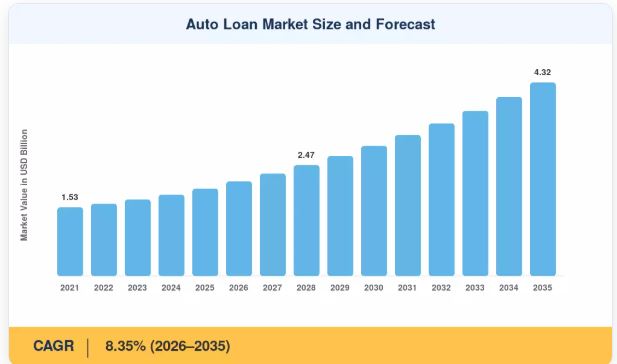
NEW YORK,, NY, UNITED STATES, September 2, 2026 /EINPresswire.com/ -- The Global auto loan market reached an estimated USD 1.94 trillion in 2025 and is projected to grow from USD 2.10 trillion in 2026 to USD 4.32 trillion by 2035, registering a CAGR of 8.35% during the forecast period. Two major catalysts are accelerating this trajectory: the sustained global appetite for personal vehicle ownership particularly in emerging economies where motorization rates continue to climb and the rapid digitization of auto financing platforms that is compressing loan origination timelines from days to minutes. With global vehicle sales surpassing 89 million units annually and electric vehicle (EV) adoption creating new financing complexity, lenders face mounting pressure to modernize credit assessment and loan servicing infrastructure or risk competitive disadvantage.— Market Research Future (MRFR)
Legacy dealer-centric financing models long dominated by captive finance arms of automakers and regional bank networks are rapidly giving way to digital-first lending platforms that integrate AI-powered credit scoring, open banking data feeds, and embedded finance capabilities directly within online and in-dealership purchase journeys. A recent Oliver Wyman study estimated that top-quartile digital auto lenders leveraging alternative data in underwriting achieved approval rates 19–23% higher than peers relying solely on traditional FICO-based models, while simultaneously reducing default rates. This technology shift is not incremental it represents a structural re-platforming of how the entire auto finance industry assesses risk and serves borrowers.
Get Full PDF Sample Copy of Report: (Including Full TOC, List of Tables & Figures, Chart) @
https://www.marketresearchfuture.com/sample_request/22818
➤ How Significant Is the Auto Loan Market’s Growth?
The auto loan market has demonstrated consistent and robust expansion, rising from approximately USD 1.32 trillion in 2021 to an estimated USD 1.94 trillion in 2025, representing a healthy historical growth trajectory. The market is expected to nearly double over the next decade, driven by rising vehicle prices inflating average loan balances, growing middle-class populations across Asia-Pacific and Latin America fueling first-time vehicle ownership, and accelerating consumer preference for flexible, subscription-style vehicle financing arrangements.
The EV transition is introducing a particularly powerful growth dynamic: EVs carry higher average transaction prices than equivalent internal combustion engine vehicles, directly elevating average loan principal balances across the market. Government incentive programs including tax credits, subsidized interest rate programs, and green auto loan schemes across the U.S., EU, China, and India are simultaneously stimulating origination volumes. Financial institutions, credit unions, fintech lenders, and captive finance companies are all investing heavily in purpose-built EV loan products to capture this structural demand shift.
➤ What Does the Future Hold for the Auto Loan Market?
Artificial intelligence and alternative data underwriting stand at the forefront of the market’s next growth phase. AI-driven platforms are transforming auto lending from a document-heavy, branch-dependent process into a fully digital, real-time credit decisioning ecosystem. Machine learning models now assess repayment likelihood using open banking cash flow data, employment verification APIs, and vehicle telematics enabling lenders to approve creditworthy borrowers previously excluded by conventional bureau-score thresholds.
The growing emphasis on embedded and point-of-sale auto finance is another defining force shaping the market’s future. Consumers increasingly expect financing offers to appear seamlessly within online vehicle configurators, digital dealer platforms, and OEM direct-sale portals with pre-approved terms delivered before a dealership visit. Platforms offering instant digital pre-approval, e-contracting, and real-time dealer funding are displacing traditional multi-day approval workflows across both new and used vehicle segments.
The rise of usage-based and subscription vehicle financing models is also redefining the product landscape. As consumers in urban markets increasingly favor flexible ownership alternatives over traditional 48–72 month amortizing loans, lenders are developing balloon payment structures, mileage-tiered pricing, and integrated insurance-financing bundles that align repayment obligations with actual vehicle utilization patterns.
Buy this Premium Research Report at:
https://www.marketresearchfuture.com/checkout?currency=one_user-USD&report_id=22818
➤ Who Are the Key Players in the Auto Loan Market?
The auto loan market landscape is characterized by a mix of captive automaker finance arms, diversified commercial banks, credit unions, and emerging fintech lenders. Key participants shaping the competitive dynamics include:
Ally Financial — one of the largest digital auto lenders in the U.S., offering a full spectrum of new and used vehicle financing products to dealers and consumers
Toyota Financial Services — the global captive finance arm of Toyota, providing retail financing, leasing, and fleet products across 37 markets
Ford Motor Credit Company — delivering retail and commercial auto financing solutions aligned with Ford and Lincoln vehicle sales globally
General Motors Financial (AmeriCredit) — offering comprehensive auto loan, lease, and dealer financing programs supporting GM’s global vehicle portfolio
Volkswagen Financial Services — the captive finance division of the Volkswagen Group, providing mobility financing across 48 countries for 12 VW Group brands
Capital One Auto Finance — a leading independent digital auto lender operating across new, used, and refinance loan segments through its direct and dealer channels
Chase Auto (JPMorgan Chase) — leveraging its massive deposit base and digital banking ecosystem to serve new and used vehicle buyers and dealer partners
Santander Consumer USA — specializing in non-prime and full-spectrum auto lending through an extensive dealer network across the United States
Bank of America Auto Loans — offering competitive direct-to-consumer and dealer-indirect auto loan products supported by its nationwide banking infrastructure
CarMax Auto Finance — the captive lending division of CarMax, serving used vehicle buyers with in-house financing at the point of sale across 240+ retail locations
Competition in the market is intensifying as lenders race to deploy AI-powered underwriting, expand digital origination capabilities for EV and subscription products, and deepen embedded finance integrations with OEM and dealer management system (DMS) platforms. Strategic partnerships with fintech firms, open banking providers, and vehicle data aggregators are also reshaping the competitive dynamics.
➤ What Are the Emerging Trends in the Auto Loan Market?
Several transformational trends are redefining how the auto loan market evolves through 2035:
AI & Alternative Data Underwriting: Machine learning models incorporating open banking cash flows, employment API data, and telematics signals are expanding credit access for thin-file and non-prime borrowers while simultaneously improving portfolio performance.
Embedded Finance & Point-of-Sale Lending: Auto loan origination is increasingly embedded directly within OEM configurators, digital dealer platforms, and used vehicle marketplaces enabling real-time pre-approval and e-contracting without branch or dealership visits.
EV-Specific Loan Products: Purpose-built green auto loan programs featuring subsidized interest rates, battery value guarantees, and residual value protection are emerging as critical differentiators for lenders targeting the fast-growing EV buyer segment.
Digital Refinancing Platforms: Consumer awareness of auto loan refinancing is rising sharply, driven by fintech platforms offering instant rate comparisons and one-click refinancing creating a multi-billion dollar market disruption opportunity in the existing loan servicing space.
Usage-Based and Subscription Financing: Flexible vehicle ownership models offering mileage-tiered payments, integrated insurance bundling, and end-of-term ownership optionality are gaining traction in urban markets among younger, experience-oriented consumers.
RegTech & Fair Lending Compliance Automation: As regulators intensify scrutiny of AI-driven credit decisioning, lenders are deploying explainability tools, disparate impact testing frameworks, and automated fair lending monitoring to ensure compliance with ECOA, FCRA, and emerging EU AI Act requirements.
Get access to the full description of the report @
https://www.marketresearchfuture.com/reports/auto-loan-market-22818
➤ How Is the Auto Loan Market Segmented?
The auto loan market report provides a comprehensive segmentation framework:
1. By Vehicle Type: New Vehicles, Used Vehicles, Electric Vehicles (EV), Commercial Vehicles
2. By Loan Provider: Banks, Credit Unions, Captive Finance Companies, Fintech Lenders, NBFCs
3. By Loan Term: Up to 36 Months, 37–60 Months, 61–72 Months, Above 72 Months
4. By Borrower Credit Profile: Prime, Near-Prime, Non-Prime / Subprime
5. By Channel: Direct-to-Consumer (Online), Dealer-Indirect, OEM Embedded Finance, Broker / Aggregator Platforms
➤ What Are the Regional Insights from the Auto Loan Market?
North America commands approximately 38% of global auto loan market share, underpinned by the United States’ deeply embedded car ownership culture, high average vehicle transaction prices, and a mature multi-channel lending ecosystem spanning banks, credit unions, captive finance companies, and digital lenders. Rising EV adoption and growing consumer preference for direct-to-consumer financing platforms are reshaping origination dynamics across the region.
Europe holds the second-largest share at approximately 25%, with Germany, the United Kingdom, France, and Italy representing the primary markets. The EU’s accelerating EV transition underpinned by 2035 combustion engine phase-out mandates is creating substantial demand for green auto loan products. Regulatory scrutiny of AI-based credit scoring under the EU AI Act is also compelling lenders to invest in explainability and audit infrastructure.
Asia-Pacific represents the fastest-growing major region, driven by rapid motorization in India, Southeast Asia, and Indonesia, alongside China’s world-leading EV market generating record auto loan origination volumes. Government-backed vehicle financing schemes in India and government-subsidized EV purchase programs in China are particularly strong stimulants for market expansion through 2030.
Latin America is projected to register a strong CAGR of approximately 7.6% through 2035, with Brazil and Mexico as the dominant markets. Rising middle-class incomes, expanding formal banking penetration, and growing used vehicle financing demand are primary growth drivers, even as currency volatility and interest rate cycles create periodic headwinds for loan origination volumes.
Middle East & Africa and South America round out the global picture, with Saudi Arabia, the UAE, and South Africa representing the most active markets for auto loan product innovation and digital lending platform adoption in their respective regions.
➤ FAQ
How does open banking affect the auto loan market competitive landscape?
Open banking lets fintech lenders access real-time bank transaction data for income verification, cutting fraud and improving approval speed [9]. This levels the playing field against deposit-holding banks.
What is the typical dealer reserve structure in indirect auto lending?
Dealers earn a reserve of 100–250 basis points on indirect auto loans by marking up the buy rate from the originating lender. CFPB scrutiny is compressing these margins.
➤➤➤ Industry Analysis Reports by Market Research Future:
Ai In Accounting Market-
https://www.marketresearchfuture.com/reports/ai-in-accounting-market-22351
Cross Border Payments Market-
https://www.marketresearchfuture.com/reports/cross-border-payments-market-22854
High Yield Bonds Market-
https://www.marketresearchfuture.com/reports/high-yield-bonds-market-22949
Wealth Management Software Market-
https://www.marketresearchfuture.com/reports/wealth-management-software-market-23061
Mainframe Market-
https://www.marketresearchfuture.com/reports/mainframe-market-23155
Forex Cards Market-
https://www.marketresearchfuture.com/reports/forex-cards-market-23847
Debit Card Market-
https://www.marketresearchfuture.com/reports/debit-card-market-23925
Shadow Banking Market-
https://www.marketresearchfuture.com/reports/shadow-banking-market-23999
Extended Warranty Market-
https://www.marketresearchfuture.com/reports/extended-warranty-market-24100
Corporate Lending Market-
https://www.marketresearchfuture.com/reports/corporate-lending-market-24324
Market Research Future
Market Research Future
+1 855-661-4441
email us here
Legal Disclaimer:
EIN Presswire provides this news content "as is" without warranty of any kind. We do not accept any responsibility or liability for the accuracy, content, images, videos, licenses, completeness, legality, or reliability of the information contained in this article. If you have any complaints or copyright issues related to this article, kindly contact the author above.
