

Microcatheters Market to reach USD 2.98 Billion by 2035 at 4.35% CAGR
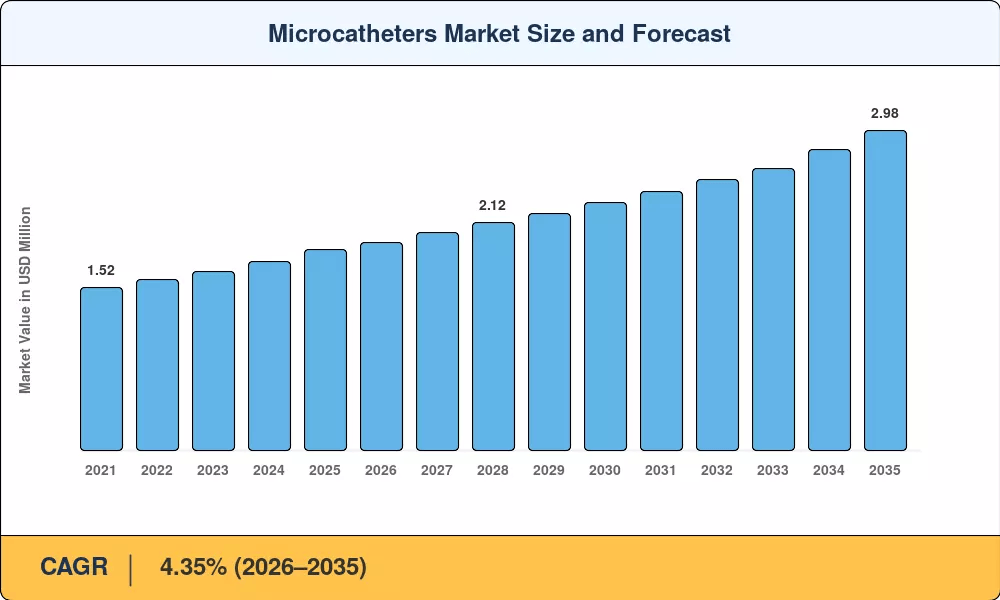
Microcatheters Market Size
Microcatheters Market to Grow from USD 1.94 Bn in 2026 to $ 2.98 Bn by 2035- By Rising Stroke & Cardiovascular Intervention Volumes, Material Science Innovation
NY, CA, UNITED STATES, June 17, 2026 /EINPresswire.com/ -- As per Market Research Future, the global Microcatheters Market size is projected to reach USD 2.98 Billion by 2035 from USD 1.94 Billion in 2026, at a CAGR of 4.35% during the forecast period 2026–2035. The market base was estimated at USD 1.87 Billion in 2025.The 4.35% CAGR—anchored by structural interventional-cardiology demand rather than discretionary healthcare spending—is driven by three converging forces: rising stroke and cardiovascular intervention volumes that continue to widen the addressable patient base for minimally invasive catheter tools, sustained material science and coating innovation that has pulled microcatheter platforms from routine coronary access into complex neurointerventional and peripheral vascular navigation, and ambulatory surgery center channel migration that has converted catheter-based procedures from inpatient cost centers into outpatient reimbursement priorities tied to percutaneous coronary and peripheral intervention efficiency.
National governments and multilateral health organizations are amplifying this momentum. The WHO estimates over 7.6 million new ischemic stroke cases annually, with mechanical thrombectomy eligibility windows extending to 24 hours for large-vessel occlusions under updated AHA/ASA guidelines. The U.S. Centers for Medicare & Medicaid Services broadened outpatient catheterization coverage in 2024, channeling an estimated USD 1.2 billion in incremental procedural spending toward small-bore vascular catheter technologies.
China's NMPA has fast-tracked neurointerventional device registrations through its Green Channel pathway, reducing Class III medical import review timelines to approximately 14 months. Together, these initiatives are creating the procurement infrastructure and delivery innovation on which the Microcatheters Market depends.
Request A Free Sample:
https://www.marketresearchfuture.com/sample_request/10610
Key Market Trends & Growth Drivers
Rising Stroke and Cardiovascular Intervention Volumes
Global epidemiological datasets show that the incidence of ischemic stroke remains a major healthcare concern, with over 7.6 million new cases reported each year. For certain patients with observable tissue mismatch, the clinical eligibility window for mechanical thrombectomy in large-vessel occlusions extends up to 24 hours after onset. This criterion was structurally formalized by the AHA/ASA guidelines after seminal clinical investigations. Increasing patient eligibility directly scales device utilization volume since each intricate mechanical thrombectomy treatment typically requires one to three neurointerventional microcatheter units to navigate convoluted anatomy. Institutional procurement budgets for specialist endovascular access tools are greatly increased domestically as a result of this volume expansion.
Extended survival in cardiovascular disease populations—driven by PCI and structural heart interventions sustaining long-term cardiac output—creates a larger prevalent population requiring sustained arterial microcatheter navigation. Longer post-intervention survival transforms coronary artery disease from an acute-mortality diagnosis into a chronic condition with sustained small-bore vascular catheter utilization. Early-adopter health systems report that AI-enhanced angiographic platforms detect distal vessel lesions at subclinical stages, converting patients who would previously have presented with acute MI into candidates for preventive percutaneous intervention. Deep-learning algorithms trained on millions of angiographic sequences now detect vascular pathologies 18–24 months earlier than conventional diagnostic catheterization.
Material Science and Coating Innovation
Legacy stainless-steel guidewire-dependent systems are giving way to braided-polymer and hydrophilic-coated neurointerventional microcatheter platforms that deliver superior tip-tracking accuracy across tortuous anatomies. Third-generation hydrophilic coatings reduce arterial microcatheter navigation friction by up to 40% compared to earlier PTFE-lined devices, per bench-testing data published in the Journal of Vascular and Interventional Radiology. Braided-polymer hypotube construction now enables outer diameters as small as 1.7 Fr while maintaining push-force transmission above 95% efficiency. These improvements directly expand the addressable anatomy for endovascular access device deployment into the distal cerebral and hepatic vasculature previously unreachable with conventional catheter designs.
Teleflex's €760 million acquisition of BIOTRONIK's vascular-intervention unit in 2024 signaled how seriously manufacturers view integrated endovascular access device portfolios. Advanced manufacturing techniques—including laser-cut hypotube extrusion—are trimming unit costs by an estimated 8–12% per generation cycle. The convergence of diagnostic catheterization with therapeutic microcatheter delivery is creating integrated platform strategies that personalize minimally invasive catheter tool selection at scale. Stryker committed USD 4.9 billion to acquire Inari Medical, expanding its thrombectomy and access device portfolio. By 2030, an estimated 40% of newly diagnosed large-vessel occlusion stroke patients will undergo AI-guided catheter navigation followed by matched mechanical thrombectomy, creating a diagnostic-therapeutic revenue loop.
Ambulatory Surgery Center Channel Migration and Reimbursement Expansion
CMS expanded its ASC-covered procedure list in January 2024, adding 11 peripheral and coronary catheterization codes. Ambulatory settings now handle an estimated 18% of diagnostic catheterization volumes in the U.S., up from 12% in 2021. This shift compresses per-procedure reimbursement by roughly 30% relative to hospital outpatient departments, incentivizing the adoption of cost-effective minimally invasive catheter tools that deliver clinical equivalence at lower price points. Manufacturers such as Merit Medical and Terumo have launched ASC-specific procedure kits to capture this channel.
The move from hospital inpatient to ambulatory surgery center settings decreases facility overhead from 30–60 minutes of chair time to streamlined outpatient workflows per treatment. Community catheterization clinics and ambulatory surgical centers are seeing a rising preference for pre-packaged microcatheter kits due to lower operating costs and higher patient throughput. This convenience-driven adoption is expected to open up incremental revenue for the Microcatheters Market in settings lacking full hybrid operating theater infrastructure. China's provincial hospital modernization program allocated CNY 48 billion for interventional suite upgrades through 2027, instantly extending minimally invasive catheter tool coverage to over 800 county-level hospitals. India's Ayushman Bharat scheme has funded 670 new cardiac catheterization labs since 2021, making endovascular access procedures accessible to more than 900 million previously underserved individuals.
Ask for Customization:
https://www.marketresearchfuture.com/ask_for_customize/10610
Market Segment Insights
BY PRODUCT
Delivery Microcatheters: Dominant segment with ~37.2% revenue share in 2025. Reflecting widespread adoption in embolization and stent-delivery workflows. Delivery microcatheters anchor institutional formularies globally due to their procedural breadth across cardiovascular, neurovascular, and peripheral interventions. Hospital procurement teams treat them as default first-line agents, and their compatibility with existing guidewire inventories has enabled broad adoption even in cost-sensitive emerging markets.
Steerable Microcatheters: Fastest-growing product segment at 5.40% CAGR (2026–2035). Driven by new neurointerventional suite demands and expanding complex navigation indications. Steerable microcatheters with shape-memory-alloy tip mechanisms and torque-responsive braiding patterns capture premium pricing in this sub-segment. Manufacturers investing in enhanced navigational precision are restructuring the growth profile of the Microcatheters Market as thrombectomy-eligible patient populations expand.
BY DESIGN
Single-Lumen: Dominant design with ~70.1% share in 2025. Driven by cost efficiency in routine coronary interventions. Single-lumen systems dominate the Microcatheters Market by volume, serving as the default configuration for standard angiographic and embolization procedures. Their simplicity translates to lower manufacturing costs and broad compatibility with existing guidewire inventories.
Dual-Lumen: Fastest-growing design segment at 5.80% CAGR (2026–2035). Enabling simultaneous contrast injection and wire exchange. Dual-lumen designs eliminate catheter exchanges during complex procedures—saving 5–8 minutes per case and reducing small-bore vascular catheter-related vessel trauma. Adoption is concentrated in high-acuity neurovascular and peripheral-intervention centers where procedural efficiency directly impacts patient throughput.
BY APPLICATION
Cardiovascular: Dominant application with ~43.8% revenue share in 2025. PCI and structural heart interventions anchor the largest application share within the Microcatheters Market, reflecting the global burden of coronary artery disease and the widespread availability of catheterization-lab infrastructure. The inherent procedural volume of percutaneous coronary intervention drives sustained dual-channel demand for arterial microcatheter navigation devices.
Neurovascular: Fastest-growing application segment at 6.20% CAGR (2026–2035). Reflecting thrombectomy guideline expansion that extends the window for neurointerventional microcatheter utilization. Mechanical thrombectomy eligibility criteria formalized by AHA/ASA guidelines create a larger prevalent population requiring sustained neurointerventional microcatheter therapy. Each mechanical thrombectomy consumes arterial microcatheter navigation devices at higher ASPs than routine coronary procedures, making neurovascular the premium-value application tier.
BY END USER
Hospitals: Largest segment with ~79.2% share in 2025. Comprehensive interventional infrastructure and complex procedure requirements dominate volume. Hospitals remain the primary delivery site for minimally invasive catheter tools due to hybrid operating theaters, anesthesia support, and post-procedural ICU access requirements.
Ambulatory Surgery Centers: Fastest-growing end-user segment at 5.95% CAGR (2026–2035). Outpatient shift and cost optimization drive demand as CMS outpatient code expansions channel eligible procedures into lower-cost settings. ASCs and community catheterization clinics increasingly prescribe streamlined, pre-packaged microcatheter kits optimized for ASC workflow constraints.
Read Detailed Insights:
https://www.marketresearchfuture.com/reports/microcatheters-market-10610
Regional Outlook
North America — Dominant Market (~44.0% Share, 2025)
The United States generates approximately 82% of North American Microcatheters Market revenue, driven by the Medicare catheterization reimbursement stability, commercial insurance coverage of thrombectomy and PCI procedures as first-line interventions, and broad reimbursement for small-bore vascular catheter technologies—a single policy ecosystem that converted an inpatient-dominated market into one with a structural outpatient procedure tail. CMS reimbursement for catheterization codes under the hospital outpatient prospective payment system has driven adoption in academic medical centers, while community catheterization networks increasingly prescribe ASC-optimized minimally invasive catheter tools to manage facility capacity. The US dominates through a combination of high per-patient spending, robust payer coverage, and rapid robotic catheterization adoption.
Europe — Second Largest (USD 0.51 Billion, 2025)
Europe's Microcatheters Market reflects divergent national strategies—Germany leads regionally with high per-capita catheterization rates and DRG reimbursement, contributing 28% of regional share, while the UK historically used selective interventional targeting before broadening coverage through NHS Long Term Plan stroke investment at 4.55% CAGR. France contributes ~18.5% of regional share through national neurovascular network directives. Italy contributes steady growth on AIFA reimbursement for interventional cardiology suites. Spain is growing at sustained pace on ICTUS Plan hospital upgrades.
Asia-Pacific — Fastest-Growing Region (6.50% CAGR, 2026–2035)
Asia-Pacific is the engine of the Microcatheters Market. China holds the largest regional share with ~38% of regional revenue, driven by NMPA Class III fast-track registrations and provincial hospital upgrades—equipping over 800 county-level hospitals with interventional radiology suites by 2028, each requiring baseline inventories of minimally invasive catheter tools. India is growing at 7.20% CAGR on the back of Ayushman Bharat cath-lab expansion. Japan contributes USD 0.07 Billion through aging population demand and advanced neurointerventional adoption at steady pace. South Korea is growing at 5.80% CAGR on NHIS coverage broadening for neurovascular procedures.
Middle East & Africa — Emerging Opportunity (3.85% CAGR, 2026–2035)
The Middle East & Africa is bifurcated between well-funded Gulf states and resource-constrained Sub-Saharan nations. Saudi Arabia leads the region with Vision 2030 healthcare infrastructure, contributing ~35% of regional share—NEOM health cluster and SAR 65 billion hospital construction commitments have created pockets of excellence for endovascular access procedures. The UAE is growing at 4.60% CAGR on medical-tourism hub positioning at Cleveland Clinic Abu Dhabi and Mediclinic. South Africa contributes USD 0.01 Billion on private hospital network catheterization growth.
South America — Growing Presence (USD 0.08 Billion, 2025)
Brazil anchors South America's Microcatheters Market at ~62% of regional revenue, with the Unified Health System (SUS) funding 14 new public interventional-cardiology centers in 2024, providing a stable demand floor that smooths regional forecasts. Access to advanced neurointerventional microcatheters remains limited by import dependencies, though the Brazilian private sector is adding specialty stroke and oncology centers. Argentina is growing at 4.00% CAGR on private-sector interventional investment.
Competitive Landscape and Recent Developments
The Microcatheters Market exhibits moderate concentration, with the top five companies holding an estimated 52–58% combined revenue share. The Herfindahl-Hirschman Index sits in the 1,200–1,500 range, reflecting meaningful competition below the market leaders. Strategic M&A activity—Stryker's Inari Medical acquisition, Teleflex's BIOTRONIK vascular-unit purchase—is consolidating the mid-tier and shifting competition toward integrated platform offerings.
The competitive landscape is stratified between broad interventional portfolio leaders serving global minimally invasive catheter tool markets, neurovascular sub-specialists capturing premium-tier thrombectomy device tenders, and ASC channel specialists consolidating the cost-optimized microcatheter segment.
KEY COMPANIES AND RECENT MILESTONES
Boston Scientific (2024–2025): Maintains leadership with Direxion and Renegade microcatheter lines, commanding ~12–15% of global Microcatheters Market revenue. Broad interventional portfolio with cardiology anchor offsets pricing pressure in competitive markets.
Medtronic (2024–2025): Echelon and Headway microcatheter families reinforce neurovascular leadership, holding ~10–13% of global revenue. Robotic partnerships and integrated stroke-platform positioning sustain competitive moats.
Terumo Corporation (November 2024): Received NMPA approval for Progreat Sigma in China, expanding arterial microcatheter navigation access across 300+ provincial hospitals. Hydrophilic-coating expertise and ASC distribution reinforce ~9–12% of global revenue.
Future Outlook: 2026–2035
By 2030, precision robotic-assisted endovascular navigation will become the operating system of microcatheter-based intervention. The convergence of robotic vascular-control systems with precision imaging will reshape the Microcatheters Market through the late 2020s. By 2030, an estimated 40% of newly diagnosed large-vessel occlusion stroke patients will undergo AI-guided catheter navigation followed by matched mechanical thrombectomy, creating a diagnostic-therapeutic revenue loop. Siemens Healthineers and Philips both disclosed AI-navigation partnerships with microcatheter OEMs in 2024, targeting FDA De Novo submissions by 2027. Machine-learning algorithms trained on millions of angiographic sequences promise to reduce procedure times by 15–25% and expand the pool of operators qualified to perform complex neurointerventional microcatheter cases.
ASC-driven access expansion and AI-integrated clinical decision support will reframe cost structures by the early 2030s. The shift to ambulatory surgery centers increases procedure volumes while compressing per-procedure reimbursement by roughly 30% relative to hospital outpatient departments. While this compresses per-unit revenue, volume expansion—particularly in Asia-Pacific and South America—is projected to more than offset pricing headwinds. The net effect accelerates Microcatheters Market penetration in markets where out-of-pocket costs currently limit endovascular access procedure initiation. AI-integrated clinical decision support platforms will guide optimal sequencing of catheter-based interventions by 2028–2030. Professional societies are developing clinical-decision-support frameworks that embed AI recommendations into electronic health records, standardizing microcatheter selection criteria across practice settings.
More Related Research Insights:
https://www.marketresearchfuture.com/reports/catheters-market-3186
https://www.marketresearchfuture.com/reports/neurovascular-devices-market-5544
https://www.marketresearchfuture.com/reports/interventional-cardiology-market-8735
https://www.marketresearchfuture.com/reports/neurovascular-thrombectomy-device-market-42168
https://www.marketresearchfuture.com/reports/embolic-protection-devices-market-5978
https://www.marketresearchfuture.com/reports/guidewires-market-11544
https://www.marketresearchfuture.com/reports/angiography-equipment-market-6106
https://www.marketresearchfuture.com/reports/minimally-invasive-surgery-devices-market-7875
https://www.marketresearchfuture.com/reports/interventional-radiology-products-market-11546
Larry Wilson
WantStats Research And Media Pvt. Ltd.
+1 855-661-4441
email us here
Visit us on social media:
LinkedIn
Facebook
YouTube
X
Legal Disclaimer:
EIN Presswire provides this news content "as is" without warranty of any kind. We do not accept any responsibility or liability for the accuracy, content, images, videos, licenses, completeness, legality, or reliability of the information contained in this article. If you have any complaints or copyright issues related to this article, kindly contact the author above.
